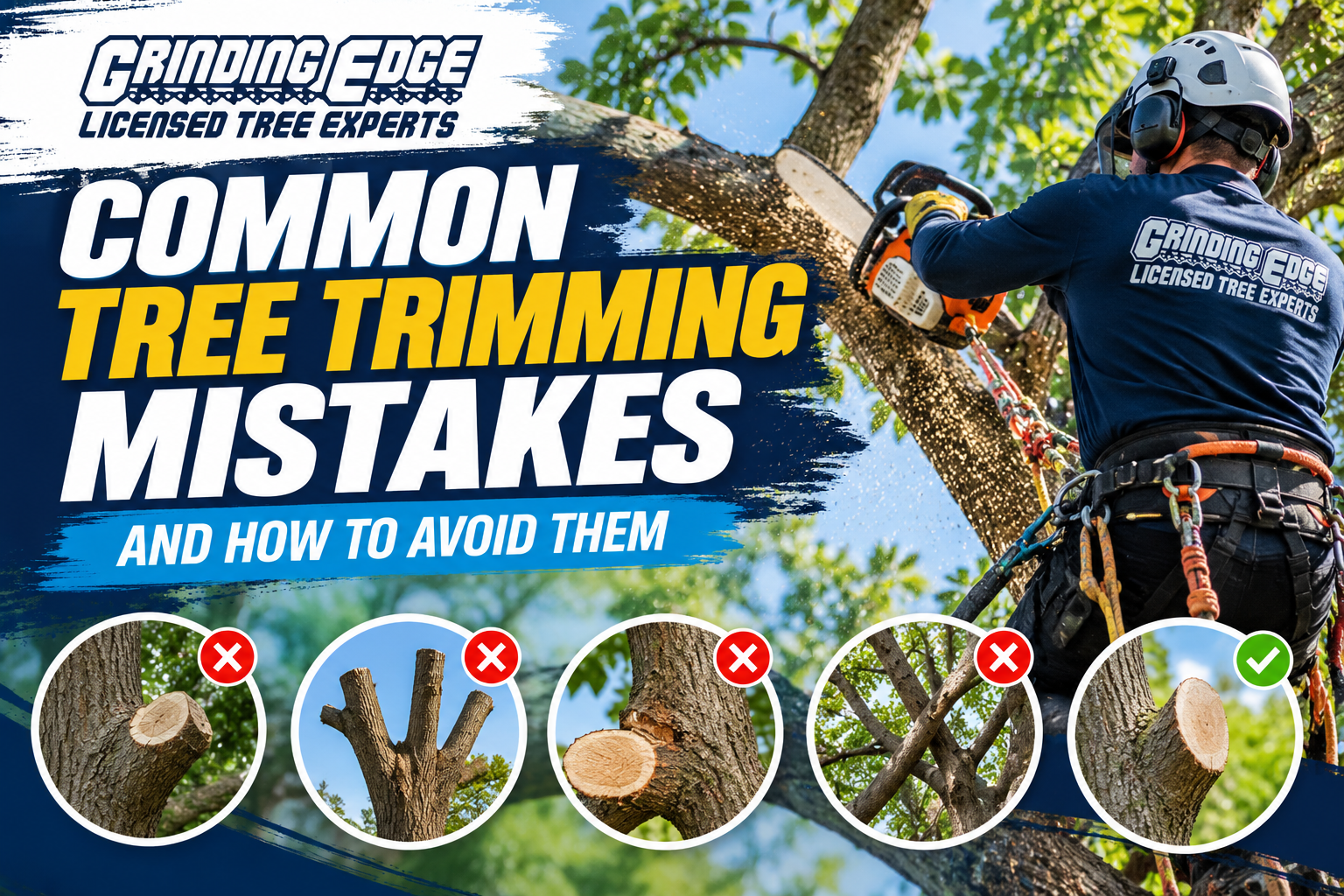
Tree trimming can improve a tree’s appearance, remove hazardous branches, and support healthy growth. However, improper pruning can do more harm than good. Cutting branches at the wrong location, removing too much foliage, or trimming at the wrong time can weaken a tree and increase the risk of disease, decay, or structural problems.
Whether you’re maintaining trees in your backyard or managing a larger landscape, understanding common tree trimming mistakes can help protect your trees and your property.
Why Proper Tree Trimming Matters
Trees don’t simply need branches removed—they need to be pruned with a purpose.
Proper trimming can help:
- Remove dead or damaged branches
- Improve structural stability
- Reduce certain safety hazards
- Improve clearance around structures
- Manage overgrown growth
- Improve the tree’s overall appearance
- Support healthy development
Poor pruning, on the other hand, can create unnecessary wounds and encourage weak or poorly positioned growth.
1. Removing Too Much at Once
One of the most common mistakes is excessive pruning.
It may be tempting to remove a large amount of growth to make an overgrown tree look smaller. However, removing too much foliage at once can place significant stress on the tree.
A tree’s leaves are essential for producing energy through photosynthesis. Removing a large percentage of the canopy can therefore affect its ability to maintain healthy growth.
Better Approach
Focus on the specific branches that actually need to be removed rather than trying to reshape the entire tree in one session.
For larger pruning projects, a qualified arborist can determine an appropriate amount of live growth to remove.
2. Topping a Tree
Tree topping involves cutting major branches or the main stem back to stubs.
It is sometimes done when homeowners want to make a tree shorter or keep it away from a building or utility line.
Unfortunately, topping can create serious long-term problems.
It may:
- Produce weakly attached shoots
- Create large pruning wounds
- Increase decay risk
- Distort the tree’s natural structure
- Reduce the tree’s aesthetic value
- Increase future maintenance requirements
Instead of topping, professional arborists may recommend selective crown reduction or another appropriate pruning technique when reducing a tree’s size is necessary.
3. Making Improper Cuts
Where you make a pruning cut matters.
Cutting too close to the trunk can damage the branch collar, while leaving an unnecessarily long stub can interfere with the tree’s natural wound response.
Proper pruning generally involves identifying the branch collar and making an appropriate cut just outside it.
For larger branches, professional pruning techniques may involve multiple cuts to reduce the risk of bark tearing.
4. Using Dull or Dirty Tools
Tree trimming tools should be sharp and appropriately maintained.
Dull equipment can make rough cuts, crush plant tissue, and make pruning more difficult.
Dirty tools can also potentially spread pathogens between trees.
Before Trimming
Inspect your equipment and make sure:
- Pruning saws are sharp
- Loppers are in good condition
- Shears are clean
- Handles and locks work properly
- Equipment is appropriate for the branch size
For larger trees, specialized equipment and professional climbing techniques may be necessary.
5. Trimming at the Wrong Time
Timing matters.
Different tree species have different pruning requirements, and the ideal timing can depend on the tree’s health, climate, growth pattern, and reason for pruning.
Some pruning can be performed during dormancy, while certain trees may have specific seasonal considerations.
Rather than following a universal calendar, identify the tree species and the purpose of the pruning first.
6. Ignoring Dead or Diseased Branches
Not every pruning project is about appearance.
Dead, broken, or diseased branches can become safety concerns and may need attention sooner than routine aesthetic pruning.
Look for:
- Dead limbs
- Broken branches
- Hanging branches
- Cracked limbs
- Signs of decay
- Unusual fungal growth
- Branches rubbing against each other
If you suspect a serious disease or structural problem, consult an arborist rather than simply cutting away random branches.
7. Leaving Branch Stubs
A branch should not simply be cut halfway and left as a long stub.
Large stubs can interfere with the tree’s natural compartmentalization and may become locations for decay or unwanted growth.
Instead, pruning cuts should be made using proper branch-collar techniques appropriate to the species and branch structure.
8. Cutting Branches That Are Too Large
Another common mistake is waiting until a branch becomes extremely large before removing it.
Large branches create larger wounds and may require more specialized equipment to remove safely.
Regular inspections can help identify problematic branches while they’re still manageable.
If a branch is large, heavy, near a structure, or located high in the canopy, professional tree trimming is generally safer than attempting the work yourself.
9. Removing Healthy Interior Growth Without a Reason
Some homeowners assume that the center of a tree should be completely open.
As a result, they remove numerous interior branches simply to create a cleaner appearance.
This can unnecessarily reduce foliage and alter the tree’s natural structure.
A well-pruned tree does not necessarily need to have a perfectly open center.
Pruning should have a specific objective, such as removing a defective branch, improving clearance, or addressing a structural concern.
10. Cutting Branches Just Because They Look Different
Trees naturally have irregular shapes.
A branch may grow at an unusual angle without actually being hazardous.
Avoid removing healthy branches simply because the tree isn’t perfectly symmetrical.
Good pruning considers:
- Tree species
- Structural strength
- Branch attachment
- Growth pattern
- Surrounding property
- Safety
- Long-term development
The goal is generally to work with the tree’s natural structure rather than force it into an artificial shape.
11. Ignoring Branches That Rub Together
Branches that repeatedly rub against each other can create wounds.
Over time, friction can damage the bark and create potential entry points for pests or pathogens.
During a pruning inspection, look for branches that:
- Cross each other
- Rub together
- Grow inward
- Have weak attachments
- Compete with a major leader
Selective pruning can sometimes resolve these structural conflicts before they become larger problems.
12. Pruning Without Considering Utility Lines
Trees growing near power lines require special attention.
Branches that contact or approach electrical lines can create serious hazards.
Never attempt to cut branches that are touching or dangerously close to power lines yourself.
Contact the utility company or a qualified professional with the appropriate training for the situation.
13. Using a Ladder for Dangerous Tree Work
A ladder may seem like a convenient way to reach a branch, but tree work can quickly become unstable.
Branches can move unexpectedly, and cutting a limb can change its weight distribution.
The combination of:
- Height
- Heavy branches
- Cutting tools
- Uneven ground
- Unpredictable branch movement
can create serious fall and impact hazards.
If you need a ladder to reach significant branches, consider hiring a qualified tree professional.
14. Trying to Handle Large Trees Without Professional Equipment
Large tree trimming isn’t simply a bigger version of trimming a small ornamental tree.
Professional tree work may require:
- Chainsaws
- Climbing equipment
- Ropes
- Rigging systems
- Chippers
- Bucket trucks
- Protective equipment
It also requires an understanding of tree structure and how branches will move as they’re cut.
When a tree is large, damaged, leaning, or close to a building, professional assistance is often the safest choice.
15. Forgetting About the Tree’s Future Growth
A common mistake is pruning based only on how the tree looks today.
Before removing a branch, consider where the tree is likely to grow over the next several years.
For example, a branch may currently be several feet away from a roof but could eventually extend toward it.
Strategic pruning while branches are smaller can sometimes prevent more aggressive pruning later.
16. Over-Pruning Young Trees
Young trees often need structural training, but that doesn’t mean they should be heavily pruned.
Removing too many branches can slow development and reduce the tree’s ability to establish a strong canopy.
Young-tree pruning should focus on developing good structure over time.
This can include addressing:
- Competing leaders
- Poorly attached branches
- Crossing branches
- Dead or damaged growth
17. Ignoring the Tree’s Surroundings
A tree doesn’t exist in isolation.
Before pruning, consider everything around it.
Check for:
- Houses
- Vehicles
- Fences
- Sidewalks
- Driveways
- Utility lines
- Other trees
- Landscaping
- People and pets
Even a relatively small branch can cause property damage if it falls in the wrong location.
18. Treating Every Tree the Same
Different species have different growth habits, branch structures, and pruning requirements.
A pruning technique that works well for one species may not be appropriate for another.
Before trimming, identify the tree and learn about its growth characteristics.
If you’re unsure, consult an arborist who can evaluate the tree and recommend appropriate pruning.
19. Focusing Only on Appearance
A tree may look neat immediately after aggressive pruning but become weaker over time.
Good tree care balances aesthetics with:
- Health
- Structure
- Safety
- Species characteristics
- Long-term growth
The objective shouldn’t simply be to make a tree look smaller or more symmetrical.
It should be to help the tree remain healthy and structurally sound.
20. Assuming DIY Tree Trimming Is Always Cheaper
DIY pruning may make sense for small branches that can be safely reached from the ground.
However, larger jobs can require equipment, disposal, specialized knowledge, and significant time.
More importantly, mistakes can result in:
- Property damage
- Tree damage
- Personal injury
- Utility hazards
- Expensive corrective work
For complex or hazardous jobs, hiring a qualified professional can be a more practical long-term decision.
When Should You Hire a Tree Professional?
Consider contacting a qualified arborist or tree service when:
- The tree is large
- Branches are near power lines
- A tree is leaning significantly
- Large branches need removal
- The tree has storm damage
- There are signs of decay
- The tree is close to a building
- You need significant crown reduction
- You’re unsure about the correct pruning technique
Professionals can evaluate the tree before cutting and determine whether pruning, removal, cabling, or another treatment is appropriate.
How to Avoid Common Tree Trimming Mistakes
Before starting a pruning project, ask yourself:
Why am I trimming this branch?
If you can’t identify a clear reason, it may not need to be removed.
Then consider:
- What species is the tree?
- Is the branch dead, damaged, diseased, or structurally problematic?
- Where is the branch collar?
- How large is the branch?
- What is below the branch?
- Could the branch contact a structure or utility line?
- Can the work be performed safely from the ground?
- Will removing this branch affect the tree’s overall structure?
If you’re uncertain about any of these questions, getting professional advice before cutting can prevent expensive mistakes.
Frequently Asked Questions About Tree Trimming
What is the biggest tree trimming mistake?
One of the biggest mistakes is removing too much of the tree’s canopy at once. Excessive pruning can stress the tree and encourage weak regrowth.
Is tree topping bad for trees?
Yes. Topping can create large wounds, encourage weakly attached shoots, and negatively affect the tree’s natural structure. Selective pruning techniques are generally preferable.
How much of a tree can you safely trim?
The appropriate amount varies by species, age, health, and pruning objective. Avoid removing excessive live growth in a single pruning session. For mature or valuable trees, consult a qualified arborist.
Should you cut branches flush with the trunk?
Generally, no. Proper pruning cuts are typically made just outside the branch collar rather than flush against the trunk.
Can you trim a tree with a chainsaw?
Chainsaws can be appropriate for certain professional tree work, but they are powerful and potentially dangerous tools. For branches that are large, elevated, or difficult to control, professional tree services are recommended.
What happens if you cut a tree branch incorrectly?
An improper cut can damage the branch collar or leave a large stub, potentially increasing the risk of decay and structural problems.
Should dead branches be removed?
Dead, broken, or hazardous branches may need to be removed, particularly when they pose a risk to people or property. The appropriate approach depends on the tree and branch condition.
Can pruning save a damaged tree?
Sometimes. Selective pruning can remove damaged or structurally compromised branches and reduce hazards. However, severely damaged trees may require a professional assessment to determine whether they can safely remain.
Should you trim branches near power lines?
Do not attempt hazardous pruning near power lines yourself. Contact the utility company or a properly qualified tree professional.
How often should trees be trimmed?
There isn’t one schedule that applies to every tree. Pruning frequency depends on species, age, health, location, growth rate, and the reason for pruning. Regular inspections are often more useful than following a rigid schedule.
Final Thoughts
Tree trimming is more than cutting branches that look out of place. Done correctly, pruning can help maintain a tree’s structure, appearance, and safety. Done incorrectly, it can create long-term problems that may be difficult and expensive to fix.
The most common mistakes include over-pruning, topping, making improper cuts, ignoring structural problems, using unsafe equipment, and trimming without considering future growth.
When in doubt, start with the simplest rule: don’t cut a branch unless you have a clear reason for removing it—and don’t attempt work that puts you, your property, or the tree at unnecessary risk.